Multi-agent runs you can replay, inspect, and trust.
Syntropy organizes autonomous agents on a mathematical lattice — hierarchy emerges from interaction, not assignment. Deterministic routing, snapshot replay, and identical math in Python and Elixir.
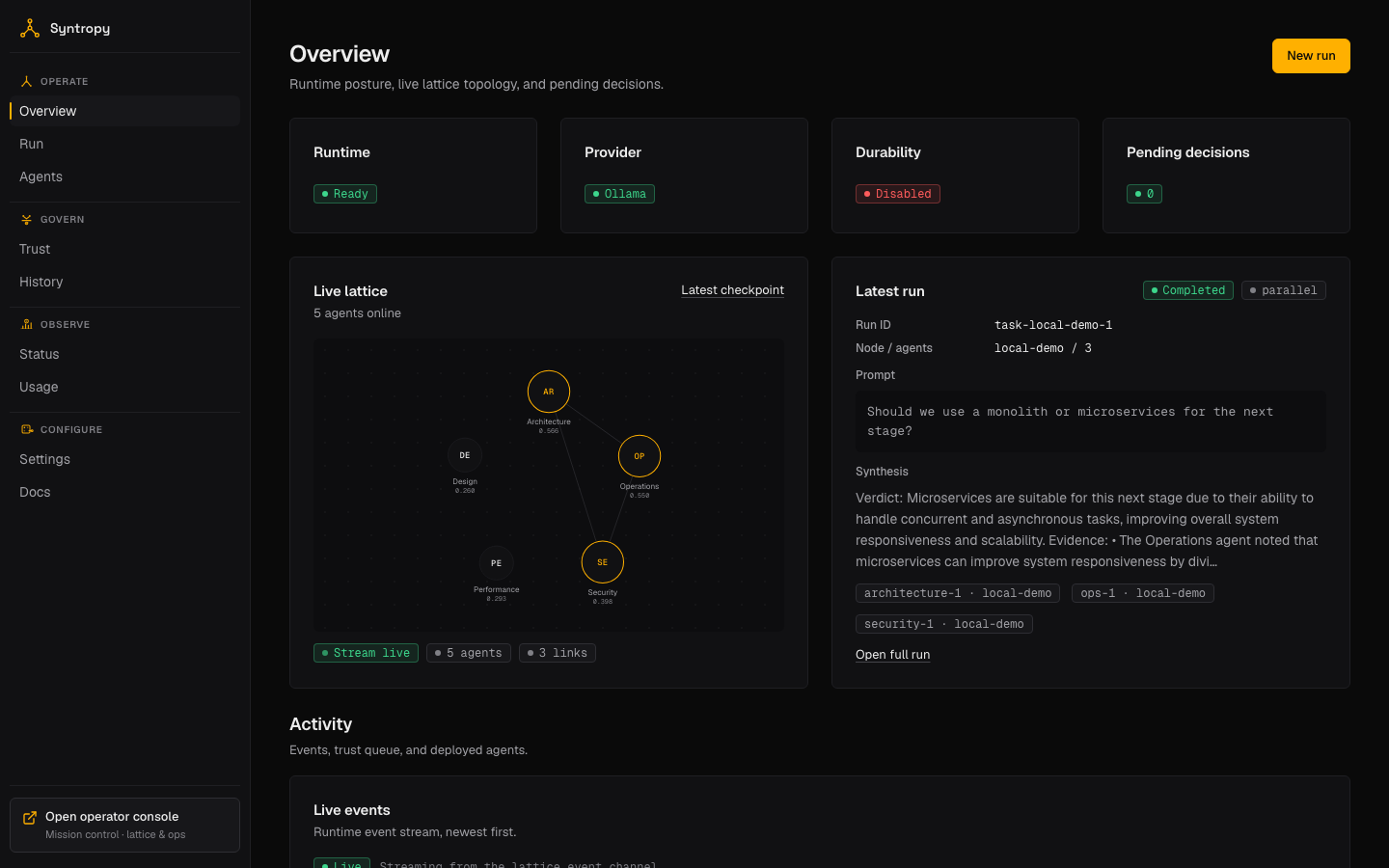
Watch a decision take shape
A replayed architecture review from the runtime: agents position themselves on the lattice, a subset is selected, and the synthesis carries structural evidence you can audit.
Massive Concurrency & Observability: Architecture Decision Review.
A team asks whether the next product stage should use a monolith, modular monolith, or microservices. Syntropy parses the intent and dynamically routes the task through a massive, distributed lattice of specialized agents on the BEAM. It selects only the most relevant perspectives, synthesizes the trade-off, and retains the execution path as an observable, replayable artifact.
- Agents
- 21
- Weighted links
- 31
- Selected
- 6
- Trigger
- recommendation_created
The runtime coordinates state on a rigorous mathematical lattice across BEAM/OTP and asyncio. Hierarchy emerges from agent interaction rather than static assignment, which keeps routing deterministic and conflict resolution auditable across distributed nodes.
Syntropy selects perspectives for the decision.
Reliability, security, and product rise first because the prompt asks for architecture risk, delivery speed, and future stage trade-offs.
The retained graph explains the recommendation.
The synthesis favors a modular monolith for the next stage, with reliability and operations carrying the strongest structural evidence against premature microservices.
Structural trust evidence stays reviewable.
A reliability-plus-operations join appears as recommendation evidence, but persistent structural change still belongs to Syntropy mission control.
Mathematically rigorous by contract
Every operation satisfies the lattice invariants below, in both the Python core and the Elixir coordination engine. Property-based tests on both sides read the same axiom contract.
a ∨ b = b ∨ aCommutativity and associativity
Final lattice synthesis is independent of agent processing order or network arrival times.
a ∨ a = aIdempotency
Duplicate observations or duplicate thought triggers do not corrupt agent positioning or state.
a ∨ (a ∧ b) = aAbsorption
Underpins conflict resolution: integrating redundant views preserves local coherence.
pos(a ∨ b) ≥ pos(a)Bounds preservation
Join and meet compute strict upper and lower boundaries for perspective aggregation.
// lattice axiomsjoin(a, b) == join(b, a)join(a, join(b, c)) == join(join(a, b), c)join(a, a) == ajoin(a, meet(a, b)) == aposition(join(a, b)) >= max(position(a), position(b))position(meet(a, b)) <= min(position(a), position(b))// shared constantsposition = 0.3*knowledge + 0.5*synthesis + 0.2*connectionsema_alpha = 0.2incomparability_epsilon = 0.05recompute_interval_seconds = 30
Start in minutes
Run a review from the Python SDK, the Elixir runtime, or the REST API.
from syntropy import Lattice

lattice = Lattice()
lattice.add_agent("Reliability Reviewer", perspective="reliability")
lattice.add_agent("Security Reviewer", perspective="security")
lattice.add_agent("Product Strategist", perspective="product")

result = await lattice.submit(
    "Should this system use a monolith, modular monolith, or microservices for the next product stage?",
    strategy="parallel",
)

print(result.synthesis)
print(result.selection_trace)
print(lattice.print_order())